Safal Mutha in a black suit, smiling

hey, I’m

Safal Mutha

सफल(suh-fuhl)means successful. I’m working on earning the name.

Class 12 in Pune. I build software that quietly runs charities, clinics and classrooms, mostly in Java, since I was twelve.

Built for real people.

One idea runs through all seven: take repetitive work off people who already have too much of it. Every project below comes with a working piece you can play with.

HopeMeals

Full stack · Donations platform · Live

A charity that runs its own back office.

Who it helpsStudents in government colleges eat without worrying about paying for it.

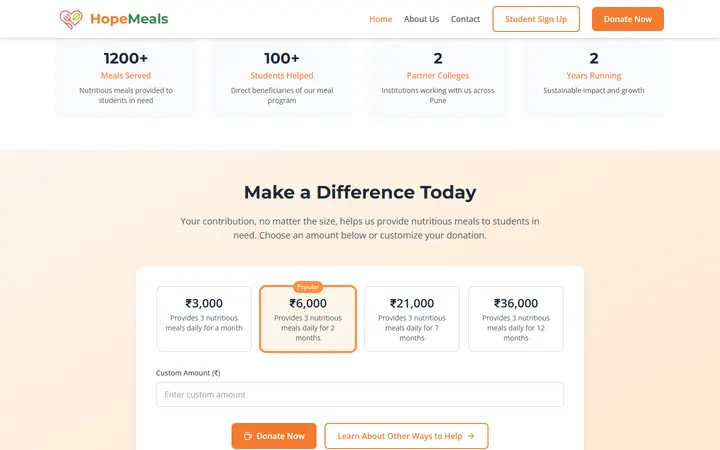
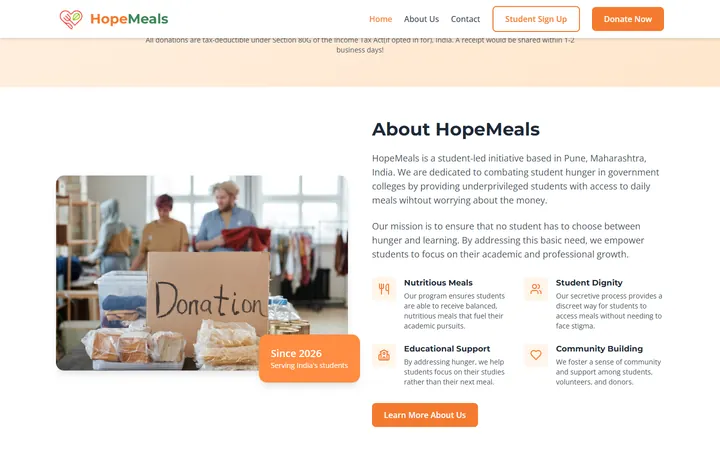
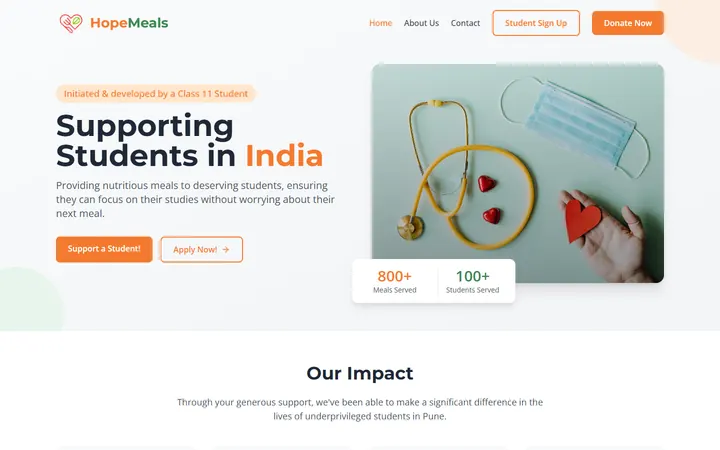
HopeMeals feeds students in Pune’s government colleges. I designed and built all of it, from the donate button to the ledger. A donor pays, and the Java backend verifies, books and receipts it before they close the tab. Every month it compiles statements and sends invites and campaigns on its own, so volunteers can spend their time on students instead of spreadsheets.

Built with Java, Maven, React, JavaScript and scheduled jobs.

What it does
  • Payment capture and server-side verification
  • Tax receipts issued instantly, statements monthly
  • Donor invites and promos on a schedule
  • More than 10,000 meals served
  • 600+ students across government colleges and orphanages
Visit hopemeals.org (opens in a new tab)
HopeMeals homepage hero: Supporting students in India, with Donate Now and Apply Now buttonsHopeMeals impact numbers and donation form with preset amountsAbout HopeMeals section describing the student-led initiative in Pune

Try the automation

Simulated. No money moves.

  1. DonationController
  2. WebhookVerifier
  3. LedgerService
  4. ReceiptService
  5. DonorLifecycleJob
Meals funded in this demo0 / 10,000
MyStop

Full stack · School transport · Deployed

Runner-up, Best Startup at IIT Bombay Techfest

Live tracking for my school’s buses, straight from the conductor’s phone.

Who it helpsParents know when the bus will reach them, and buses only stop where a child is waiting.

I built MyStop, the bus management app for my school, deployed inside Hubble Orion’s super-app. Parents watch the bus move live, see when it will reach their stop, change a day’s pickup or drop, and mark their child absent, which re-plans the route before the bus leaves. Conductors get a daily route optimised around traffic with Google Maps and tick off each pickup as it happens. Admins add accounts in one click, merge half-empty routes, set up temporary holiday routes and pull daily attendance reports.

What it does
  • Live bus location and arrival estimates for every stop
  • Pickups, drops and attendance changed day by day
  • Routes re-planned around absences and traffic
  • Call the conductor or watch the bus CCTV in the app
  • Route merging, temporary routes and daily reports

MyStop, one morning run

Simulated. Names, stops and times are made up.

SchoolIshaanAaravMeeraKabirAnaya
Every rider is on today’s route.

Aarav, pickup at Undri

Expected pickup 7:15

  • Route 1 is ready. The bus leaves the depot at 7:05.

Elite Maths Academy

Frontend · Growth website · Live

A website that answers parents’ questions before the first call.

Who it helpsA solo teacher gets a steady stream of enquiries without running ads.

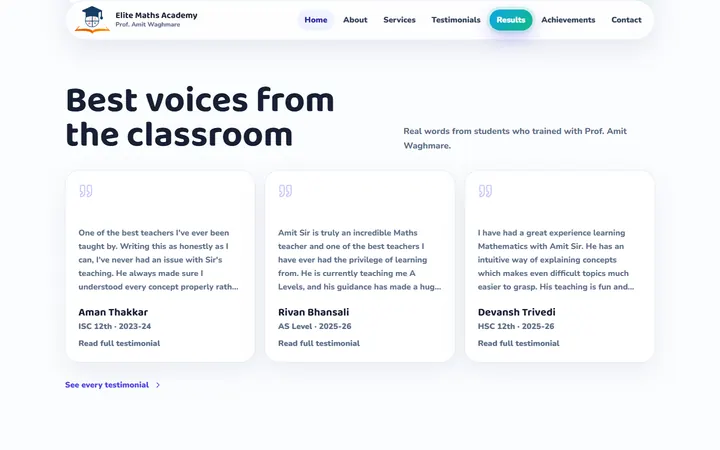
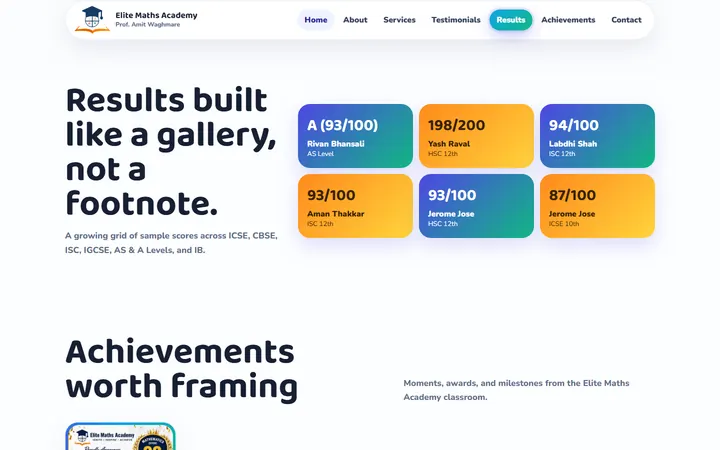
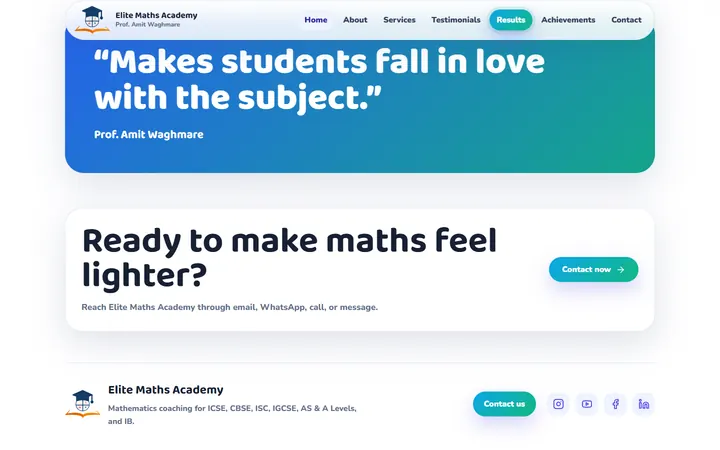
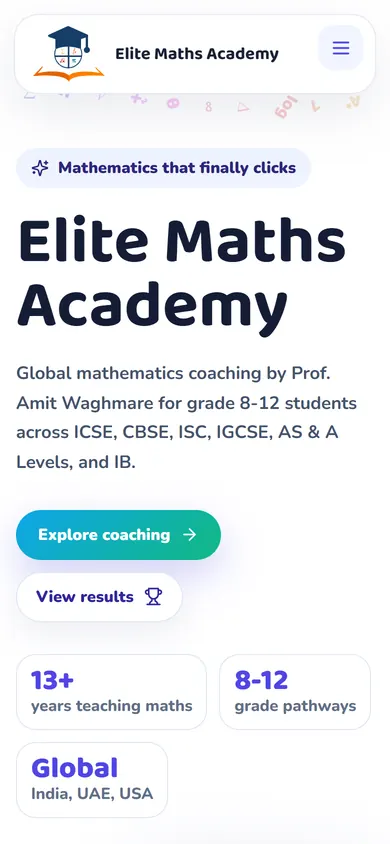
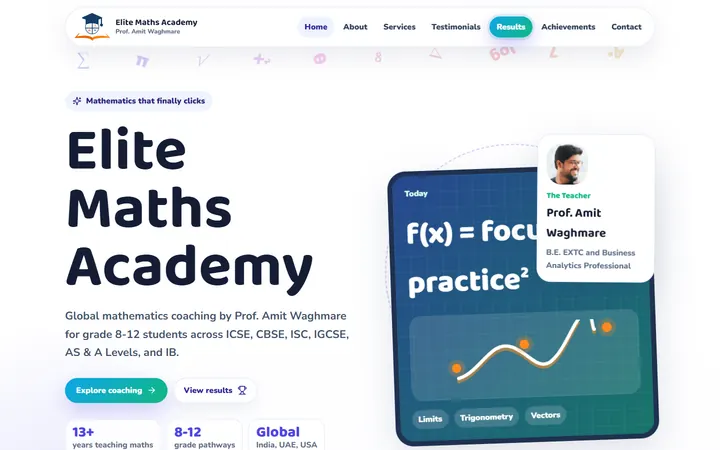
Prof. Amit Waghmare teaches maths to students across India, the UAE and the USA. I built his website: results up front, real reviews from students, and a way to enquire in one tap. It has passed 5,000 visits, and enquiries now arrive on their own.

Built with React, JavaScript, responsive UI and SEO.

What it does
  • 5,000+ visits
  • Reviews and results as the pitch
  • One-tap enquiry by WhatsApp, call or email
  • Pure React, fast on any phone
Visit elitemathsacademy.in (opens in a new tab)
Elite Maths Academy homepage hero introducing Prof. Amit WaghmareTestimonials section titled Best voices from the classroomResults gallery showing student exam scoresCall to action: Ready to make maths feel lighter, with a contact button
0+visits

A parent’s path through the site

A promise in one line, the teacher’s face beside it.

Stockroom Ledger

Desktop app · Database and receipts · In daily use

The stockroom that never loses count.

Who it helpsThe team at Arunraj Associates stopped counting stock by hand.

Arunraj Associates opens this app every morning. It tracks every item in and out, prints receipts and warns before shelves run dry. Built in Java with Maven on a relational database, where each sale and its stock change commit together or not at all. The numbers can never disagree.

Built with Java, Maven, SQL and JDBC.

What it does
  • Live stock levels with low-stock alerts
  • Receipts generated on every sale
  • Transactional writes, no drift
  • Used daily by the team

Stockroom Ledger, running

All shelves healthy

Inventory with sell and restock actions
ItemStockActions
Basmati rice, 25 kgRC-25 · ₹2,15012
Sunflower oil, 15 LOL-15 · ₹2,4806
Toor dal, 30 kgDL-30 · ₹4,3505
Sugar, 50 kgSG-50 · ₹2,3004

RECEIPTS

Sell something to print one.

-- waiting for the first sale

Rapid Test AI

Public health · Computer vision · Built

A phone camera that reads a test kit the way a lab would.

Who it helpsHealth workers get a consistent reading, even when the line is faint.

Rapid test kits are cheap. Reading them right is not: faint lines get missed, and rural clinics have no reader. Built to aid the Government of India, it is a full-stack app that scans HIV, dengue, malaria and pregnancy kits with computer vision. It measures colour depth and line opacity across the strip, so a faint positive gets caught instead of guessed.

Built with Java, Gradle, Maven, Android and computer vision.

What it does
  • HIV, dengue, malaria and pregnancy kits
  • Colour depth and line opacity analysis
  • Works on phones clinics already own
  • Aimed at rural and low-income clinics

Scan a test kit

Illustration only. Not a diagnostic tool.

Tcolour depth across membraneC

Set up a kit, then scan it.

Wedding Photobooth

Imaging engine · Live event · Delivered

Photo filters I wrote by hand, for one very big night.

Who it helpsHundreds of guests took home a photo that felt made for them.

A grand wedding, hundreds of guests, one booth. I wrote the filter engine from raw pixels up: polaroid frames, lomo vignettes, sepia, retro grain, clean modern grades and AR overlays, rendered live as guests posed. The hosts left a glowing review.

Built with image kernels, colour matrices, AR overlays and real-time rendering.

What it does
  • Hundreds of guests photographed
  • Every filter coded from raw pixel math
  • Polaroid, lomo, sepia, retro, modern, AR
  • Glowing review from the hosts

The filter engine

Pick a look.

    Bharat Ko Jaano

    Bharat Vikas Parishad · Automation · Delivered

    The question engine behind a nationwide olympiad.

    Who it helpsStudents across India competed on fresh, verified questions.

    Bharat Ko Jaano is Bharat Vikas Parishad’s pan-India cultural olympiad. Its city, state and national rounds drew their questions from a system I built. It sources, grades by level and serves questions with verified answers, so every round is fresh and no quizmaster is caught out.

    Built with Java, automation and question banks.

    What it does
    • City, state and national rounds
    • Questions graded by level automatically
    • Verified answer for every question
    • No repeats within a pool

    Question engine

    score 0/0

    Generate a round to see the engine pick a fresh, verified question.

    4 unused in state pool

    The grades, with context.

    Class 12 at VIBGYOR High, Pune NIBM, in progress. Scores mean little without the scale they sit on, so each one comes with a line of context.

    SAT

    1490/1600

    97th percentile400average1600

    Higher than 97% of test takers, out of more than 2 million. The College Board’s admissions test for US universities.

    Advanced Placement

    AP Computer Science Ain Java

    5/5

    Classes and objects, arrays and ArrayLists, 2D arrays, recursion, searching and sorting. 5 is the top score.

    AP Biology

    4/5

    Cell biology, cellular energy, genetics and gene expression, natural selection and ecology.

    Class 10 boards

    93.2%

    National board examinations at the end of Class 10.

    State topper, Unified Cyber Olympiad

    Highest score in the state in Unified Council’s Unified Cyber Olympiad, a national test of computing and cyber reasoning.

    The seal of Harvard University

    CSCI S-111Intensive Introduction to Computer Science and Data Structures

    Harvard Summer School taught by David Mulligan, Boston University professor and a Harvard graduate examined in Java 20 to 30 hours of problem sets a week

    A single fast course that runs from the first line of Java to graph algorithms. The first half is programming: types, control flow, methods, recursion, objects, files and arrays. The second half is data structures and the analysis of the algorithms built on them, which a university degree usually spreads over a second and third semester.

    8university credits completed

    Afinal grade, the highest grade the course awards

    Learning to program

    First half

    Data types, conditional execution, iteration and recursion, then object-oriented design, file handling and arrays. Everything written in Java and tested by hand before it was submitted.

    Structures and their cost

    Second half

    Lists, stacks, queues, trees, hash tables and graphs, each built twice: once over arrays and once over linked nodes. Then the classic algorithms that run on them, measured rather than guessed at.

    Unit 1 of 10

    Getting started

    Computational problem solving, the first Java programs, statements, standard output and procedural decomposition into simple methods.

    What the course expects you to leave with

    • Analyse a problem, design a solution, implement it and then test and debug the result.
    • Choose between data structures by comparing their efficiency, not by preference.
    • Think recursively, including about structures that are themselves recursive.
    • Write Java that solves a hard problem at a cost you can defend.
    What the A was made of
    • Final exam35%
    • Four unit tests30%
    • Ten problem sets25%
    • Participation10%

    Three committees, two gavels.

    Model UN puts you in a room as a country, not as yourself. You research what that country can actually sign, argue its position under parliamentary procedure, build a bloc out of the delegations whose interests overlap with yours, and try to get a resolution passed before the weekend runs out. The chair watches all of it and hands one gavel to the delegate who did it best.

    Yale Model United Nations 50 logo

    Yale Model United Nations, 50th session

    Representing Italy in UNWUN Entity for Gender Equality and the Empowerment of Women

    The first one. Italy in UN Women at the fiftieth session of the oldest conference on the circuit, in a committee of fifty whose average delegate had already done nine.

    Nothing about the room was gentle. Delegates around me had been doing this for years, knew the procedure by reflex and had blocs half formed before the first session opened. I spent that weekend learning what the rules were actually for: when a motion helps you, when a speakers list is a trap, and how quickly a committee decides who it is going to listen to.

    2,000 delegates at the conference50 of them in my committee

    Conferences behind each delegate, walking in

    Me0
    Room average9
    VIBGYOR Model United Nations logo

    VIBGYOR MUN 16

    Representing Poland in UNCSTDUN Commission on Science and Technology for Development

    Poland in UNCSTD, against a committee that averaged seven conferences each. It was my second. I won Best Delegate.

    A technology committee rewards the delegate who actually understands the technology, and that was the opening. I wrote policy I could defend line by line, took the unmoderated caucuses seriously instead of treating them as a break, and ended up holding the pen on the draft resolution. The gavel came down on my second conference ever.

    Best Delegate

    800 delegates at the conference100 of them in my committee

    Conferences behind each delegate, walking in

    Me1
    Room average7
    Oxford Global Model United Nations logo

    Oxford Global MUN India 2026

    Representing Brazil in UNESCOUN Educational, Scientific and Cultural Organization

    Brazil in UNESCO, in a committee of a hundred whose average delegate had done seventeen conferences. It was my third. Best Delegate again.

    Fifteen hundred delegates, and a committee where the average delegate had eight times my experience. The gap stopped mattering somewhere in the first unmoderated caucus: I had read the UNESCO instruments the resolution would have to live inside, I knew what Brazil could and could not sign, and I spent the weekend merging other people’s clauses into something the room could pass. Experience is a proxy for preparation. Preparation is the thing itself.

    Best Delegate

    1,500 delegates at the conference100 of them in my committee

    Conferences behind each delegate, walking in

    Me2
    Room average17
    Oxford Global Model United Nations logo

    OxfordMUN GlobalVoices

    Oxford, United Kingdomstill to come

    Sponsored to debate at GlobalVoices in Oxford, which its organisers describe as the largest high school Model UN in the United Kingdom, held inside University of Oxford college venues.

    Three conferences in, both gavels won against rooms that had been doing this for years. The next one is booked, the country and committee are still to come, and the preparation starts the day the assignment lands.

    Sponsored to attend

    Held in University of Oxford college venues, and the largest high school Model UN in the country by its organisers’ own account.

    The arithmetic of being the least experienced delegate in the room

    At Yale the room averaged nine conferences each and I had done none. At VIBGYOR the average was seven and I had done one. At Oxford Global it was seventeen and I had done two. Every one of those rooms had delegates who could quote the rules of procedure from memory and who arrived with their blocs already agreed.

    What closed the gap was not experience but preparation: reading the actual instruments the resolution would have to sit inside, writing a position I could defend under questioning, and treating the unmoderated caucus as the part that decides the weekend. Two of those three rooms gave me the gavel, the second of them against delegates carrying eight times my experience.

    250 delegates sat in the three committees I have competed in: fifty at Yale, a hundred at each of the other two. The green one is me.

    What a chair is actually scoring

    Research
    Knowing the country’s real position, the treaties it has signed and the ones it never will, before the first speech.
    Speaking
    Sixty seconds, no notes worth reading from, and a room that decides in the first ten whether to keep listening.
    Procedure
    Motions, points and the speakers list, used as tools for steering a debate rather than recited as trivia.
    Coalitions
    Finding the countries whose interests overlap with yours and getting them into one bloc before somebody else does.
    Negotiation
    Trading the clause you can lose for the clause you cannot, and staying in your country’s policy while you do it.
    Drafting
    Turning a weekend of argument into operative clauses that survive amendment and still pass.

    none of it is a speaking contest

    9 awards, 8 organisations.

    Gavels, a state topper certificate, a startup runner-up and an honours list, handed out by people who had no reason to be generous. The list below is the whole of it.

    • Best DelegateBrazil in UNESCOOxford Global MUN India 2026
    • Best DelegatePoland in UNCSTDVIBGYOR MUN 16
    • State TopperUnified Cyber OlympiadUnified Council
    • Best SpeakerHarvard Global Debate Hub
    • Best Debating Team“Failure is the best teacher for an entrepreneur”Entrepreneurial Debate, National Entrepreneurship Club Jr, IIT Bombay Techfest
    • Runner-up, Best StartupMyStopStartup Mela, National Entrepreneurship Club Jr, IIT Bombay Techfest
    • Certificate of ExcellenceCurrent Care, a project on saving energy in schoolEUMIND
    • Youngest VolunteerBharat Vikas Parishad
    • Honours ListThe Bishop’s School camp

    Showing 9 of 9.

    And the work that came without a certificate

    Anaemia Mukt Abhiyan

    Aviive Diagnostics with Bharat Vikas Parishad

    Testing schoolchildren for anaemia at camps run across the city, so the ones who need iron are found before it shows up in their marks.

    Bharat Vikas Parishad

    Youngest volunteer on the rolls

    Years of Sunday work with a national voluntary organisation, which is also where the Bharat Ko Jaano question engine came from.

    HopeMeals started the same way, on a Sunday, and is now its own thing entirely. It has its own chapter above.

    Better diagnosis, no new hardware.

    Can SaMD Enhance Diagnostic Consistency and Turnaround Time in Resource-Constrained Public Healthcare Settings without Hardware Modification?

    Research paper by Safal Mutha · International Journal of Advance Research, Ideas and Innovations in Technology (IJARIIT), Vol. 12, Issue 3, 2026

    A review of whether software, especially AI tools, can make diagnosis faster and more consistent in under-resourced public clinics without replacing their equipment. It finds that it can cut turnaround times and disagreement between readers, and that the real obstacles are regulation, cybersecurity, algorithms drifting over time and who pays.

    SaMD means Software as a Medical Device: software that does a medical job on its own, with no special machine attached.

    1. Software, not hardware

      Runs on devices clinics already have. Nothing to buy, ship or repair.

    2. Consistency

      The same kit should read the same way in every clinic, for every reader.

    3. Turnaround

      Results at the point of care in minutes, not days through a distant lab.

    See the app it connects to

    It started with a block game.

    How I learned to code: at twelve I wanted Minecraft to do things it couldn’t. So I made it. Java, Gradle and Maven came along for the ride.

    Learning curveIdeas become features
    1. MCreator

      Age 12

      Drag-and-drop mod making. A first custom sword, a texture drawn pixel by pixel, and one dangerous thought: what if I could change the rules?

    2. Bukkit and Spigot

      Plugins

      Real Java at last. Event listeners, commands, a plugin.yml, and a NullPointerException that took down a friends-only server mid-game.

    3. Functions and JSON

      Datapacks

      mcfunction files, loot tables and advancements. Logic with no compiler to save me, debugged one /say at a time.

    4. Forge and Fabric

      Mods

      Gradle builds, mappings, registries and mixins into a decompiled game. The first Gradle sync felt eternal. The first working mod felt like magic.

    5. Published on CurseForge

      Shipping

      Silly, funny mods released for anyone to download. None became famous. Every one taught me how to finish and ship.

    None of those mods became popular. It was still the best learning curve of my life.

    Quick answers.

    The questions that come up in every first email, answered once, here.

    Who is Safal Mutha?

    A Class 12 student at VIBGYOR High, Pune NIBM in Pune, India, who builds software: Java back ends, React front ends, and the websites and apps around them. He has been writing code since he was twelve, when he started modding Minecraft.

    What does he actually build?

    Full-stack web applications, Android apps, desktop tools and the websites that sit in front of them. That includes a donations platform with server-side payment verification, a live bus-tracking app for a school, a stock ledger with transactional writes, and a computer vision reader for rapid test kits.

    What does he work with?

    Java with Maven and Gradle on the back end, React and TypeScript on the front end, SQL for storage, Android and computer vision where a phone is the device, and plain hand-written CSS for design, responsive layout, accessibility and performance.

    Has any of it shipped to real users?

    Yes. HopeMeals is live at hopemeals.org, Elite Maths Academy is live and past 5,000 visits, Stockroom Ledger is opened every morning by Arunraj Associates, MyStop was deployed for a whole school inside the Hubble Orion super-app, and the Bharat Ko Jaano question engine ran a pan-India olympiad.

    What has he studied beyond school?

    Harvard Summer School CSCI S-111, Intensive Introduction to Computer Science and Data Structures, completed for eight university credits with a final grade of A. AP Computer Science A at 5 out of 5, AP Biology at 4, and a peer-reviewed paper published in IJARIIT.

    Who designed and built this website?

    He did, from an empty folder: React 19, TypeScript and Vite, hand-written CSS with no framework, a Three.js voxel island you can mine blocks out of, and a prerendered static build that ships no tracking of any kind.

    How do I get in touch?

    Email [email protected], call or message +91 86699 00008, or write a note straight from the contact section of this page. He is also on LinkedIn as muthasafal.

    I compiled some dad jokes I like about coding

    Safal in a navy blazer and red tie, smiling

    Why did the Java developer wear glasses?

    Give me a process. I’ll make it run itself.

    I’m , and you can write back to .

    I’m writing about

    Cheers,

    Opens your email app with this note filled in, ready to send. Nothing is sent to or stored on this site. Ctrl Enter sends from the message box.